
-- Fidelity's Active Funds Pull Ahead In Disruptive 12-Month Period
Past Viewpoints:Fidelity's Active Funds Pull Ahead In Disruptive 12-Month Period
A recent column published by Morningstar asks, "Have We Been Too Hard On Active Funds?" It’s a timely question. The mass media has spent two decades chastising active investors while extolling the benefits of indexing, which in turn has had a pronounced effect on the mutual fund industry.
But now, in an emerging age of AI disruption – one in which S&P 500 companies can no longer assume that carefully crafted moats will protect their market share, we have a situation where savvy fund managers – backed by internal research – may have regained their catbird seats, allowing them to enjoy a 1990s-like tailwind.
How long this will go on is anyone’s guess. During the 15 years that followed the 2008 Financial Crisis, S&P 500 companies restructured, consolidated and embraced stock buybacks, creating an environment where there were few surprises and even fewer long-term losers. The logic of paying an active manager to sort winners from losers was called into question by many. In a truly efficient stock market, they argued, there would be no value to be gained.
Over the last year, however, we’ve seen a growing number of examples where the market’s collective wisdom was way off the mark. Tariffs, which were widely assumed to have only negative economic effects, turned out to be more like a corporate tax increase and far less inflationary than expected. The rollout of AI technology and its anticipated negative impact on hiring was expected to cause a deep slide in consumer spending, which didn’t happen. The consensus belief that too much AI data-center capacity is being built has so far been flat-out wrong, and is sharply at odds with the views of the world’s smartest CEOs, who would never have created such enormous value if their capital-allocation skills were deficient. But the prognosticators don’t give up – they claim we’re in a bubble based on debt and history, without necessarily having a full understanding of AI’s capability.
Fidelity 12-month Results
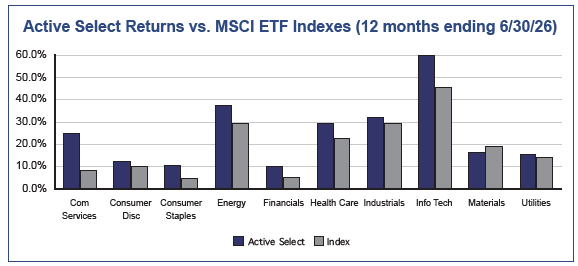
Meanwhile, the contrarian view is paying off, most prominently in the large-cap growth category, where 10 out of 13 Fidelity funds have outperformed the Russell 1000 Growth benchmark over the last year – several by margins of more than 15 percentage points! In the largecap blend category, 7 out of 8 funds exceeded the S&P 500 over the last twelve months, a significant improvement over the mixed picture at the end of June last year. Fidelity’s large-cap value funds are still lagging as a group, with only one 1 out of 5 funds beating the Russell 1000 Value. But a majority of their active funds beat category benchmarks in mid-cap growth, mid-cap blend, mid-cap value, and small-cap growth, leaving small-cap blend and small-cap value as the remaining categories where indexing still appears to be the better bet.
The Future May Not Be Like The 2008-2023 Period
As the AI era takes hold, there are sure to be many more surprises. Stock market efficiency, at least today’s version of it, depends a lot on consensus earnings estimates by stock analysts, numbers that are becoming increasingly difficult to project and therefore more divergent depending on the views of the analysts creating the estimates. This lack of consensus, which exists for just a handful of stocks today, may become a more common situation as time goes on, compromising the market’s collective wisdom. Smart and experienced fund managers, on the other hand, may find that companies benefitting from AI technology are relatively easy to identify, much like the chipmakers have been.
At the same time, AI technology may also be used to improve the results of quantitative funds. Any way you look at it, the ground upon which the promise of passive investing rests may not be as rock-solid as many Bogle-heads (index proponents) believe. AI might progressively boost the return on active management expenses over time. Indexing, while still a prudent and dependable way to invest over the long run, may not be the easy ticket for landing in the top 10% of any given performance category in the future.
Second Quarter Review
The second quarter brought strong earnings and signs of robust demand for AI compute, prompting the stock market to look past the situation in the Strait of Hormuz and the inflationary implications that went with it. Growth stocks, following a weak first quarter, surged as memory chipmakers (along with other suppliers of data-center components) led the advance. But the rally also broadened to include value stocks, mid-caps and small-caps as a 60-day agreement between the U.S. and Iran set the stage for Mid East oil exports to potentially begin a slow return to normal. The S&P 500 jumped 15.2% for the quarter, finishing with a year-to-date gain of 10.2%.
While the short-term inflationary impact of higher oil prices was significant, bond investors were not too concerned about the longer-term implications given the ongoing progress toward reopening the Strait. As such, yields on intermediate bonds rose, but the long end of the yield curve saw little change. The U.S. Aggregate Bond Index finished the quarter with a gain of 0.7%, for a year-to-date increase of 0.6%.
On the stock side, our sector holdings outperformed thanks to favorable results (relative to benchmarks) in most of Fidelity’s active Selects – most importantly Select Technology, where we held a market weighting of around 30% throughout the quarter. Our diversified stock fund holdings ended mixed, with some portfolios slightly outperforming and others trailing a bit due to an overweighted value-stock position. On the bond side, our focus on intermediate and short-maturity bonds was on par with the U.S. Aggregate Bond Index’s modest return.
Looking Ahead
Bond market expectations for inflation over the next decade finished the quarter just above 2.2%, down slightly from the where it was at the end of the first quarter. Why so modest at a time of oil-driven inflation? Persian Gulf oil exporters are aggressively developing alternative transportation infrastructure for moving crude, while the U.S. and Canada continue to expand exports of LNG as domestic natural gas supplies outpace demand. So regardless of how the situation with Iran plays out, in 2-3 years there is not likely to be a global shortage of fossil fuels, and there might even be an oversupply.
The forward P/E ratio for the S&P 500 is just above 20, having declined from around 22 at the beginning of the year. That’s because earnings grew faster than stock values in the first half. With the pace of earnings growth expected to remain robust over the next four quarters, we could see forward P/E ratios shrink even further, perhaps even as the market continues to post modest gains. While AI investment and tech stocks are by far the biggest component of this earnings boom, it is also spreading into other sectors, helping to pull mid-caps and small-caps out of a long-term slump.
On the stock side, improved performance among Fidelity’s active large-cap blend funds is prompting us to boost weightings in that segment, making some diversified portfolios less dependent on funds that lean heavily toward growth or value. We expect to continue that shift. As for our sector mix, we’re taking a closer look at the defensive side of the portfolio as we search for a better way to offset volatility from our large (market-weighted) bet on the technology sector. That could lead to a more diversified bet on healthcare stocks, boosting exposure to consumer staples, or replacing consumer staples with an alternative defensive bet that further reduces overall portfolio risk.
On the bond side, strong performance (relative to benchmark) by Fidelity’s High Income fund prompted us to cut exposure to Intermediate Bond in order to make room for an allocation to high-yield bonds in our Income portfolios. We might make a similar move in some of our blended portfolios later this year.
Sincerely,

Jack Bowers
President & Chief Investment Officer